
The Stress Training Connection, Why Your Lifestyle Affects Your Results
Introduction
Every experienced coach has had this conversation. A member trains hard, eats well by any reasonable standard, and still cannot shift stubborn body fat around the midsection. They still wake up tired. They still are not recovering between sessions the way they were six months ago. The missing variable almost never shows up in a food diary or a training log.
It shows up in a stress hormone most people have heard of but very few understand properly, cortisol. This article unpacks the connection between the stress in your life and the results you see, or do not see, in the gym, and gives you tools that go further than the generic advice to "just relax".
Chapter 1: The Missing Variable in Most Training Programs
Most training programs are built to optimise three variables, load, volume and recovery time. That is a reasonable starting point, but it assumes recovery capacity is constant. It is not. A member's ability to recover from a session on a calm week and their ability to recover from the same session during a chaotic week at work are two entirely different physiological states, even though the training log looks identical.
This is why two members can follow the same program and get different results. The program is not the whole equation. Life stress is an invisible input that changes how much of the training signal actually gets converted into adaptation.
The landmark HERITAGE Family Study put numbers on this variability, tracking more than 700 people through 20 weeks of identical, fully supervised aerobic training and finding cardiorespiratory fitness gains ranging from almost no improvement to gains of roughly 1,000 millilitres per minute in oxygen uptake, on the same program (Bouchard et al., 1999). More recent work has shown that much of what looks like non response is dose dependent rather than fixed, meaning the training input, and everything competing with it for the body's recovery capacity, matters as much as genetics (systematic review on trainability classification, Frontiers in Physiology, 2021).
Chapter 2: Meet Cortisol, What It Actually Does
Cortisol has a reputation as the villain of body composition, but that reputation is only half accurate. Cortisol is a survival hormone, released by the adrenal glands in response to any perceived demand on the body, physical or psychological. In the right dose, at the right time, it is essential. It wakes you up in the morning, mobilises energy for a hard training session, and sharpens focus under pressure.
The problem is not cortisol itself. The problem is chronically elevated cortisol, the kind that comes from a nervous system that never gets the signal it is safe to stand down. That is the state that starts working against training results rather than supporting them.
Physiologically, the response runs through the hypothalamic pituitary adrenal axis, a three step cascade starting with corticotropin releasing hormone from the hypothalamus, triggering adrenocorticotropic hormone from the pituitary, which then signals the adrenal glands to release cortisol (HPA axis physiology, reviewed in stress neuroscience literature). Research on acute activation of this system shows moderate, short lived cortisol elevation is associated with enhanced attention and vigilance, exactly what you want walking into a heavy training session or a high pressure meeting. The damage only begins when the system cannot switch off.
Chapter 3: Cortisol and Body Composition, the Real Mechanisms
Chronically elevated cortisol affects body composition through several concrete mechanisms, not vague hand waving. It raises blood sugar by promoting glucose release from the liver, which over time pushes insulin higher and encourages fat storage, particularly visceral fat around the midsection.
It also increases cravings for energy dense, high sugar food, because the body interprets chronic stress as a signal to seek fast fuel. On top of that, sustained high cortisol promotes muscle protein breakdown, which works directly against the resistance training a member is doing to build or preserve lean mass. This is why someone can be training and eating well and still see their midsection resist change, the hormonal environment is working against the very adaptation they are training for.
Visceral fat tissue itself carries a notably higher density of cortisol receptors than subcutaneous fat, which is part of why stress preferentially deposits fat around the midsection rather than elsewhere (research on HPA axis and visceral fat mechanisms). On the appetite side, foundational work by Elissa Epel and colleagues found that women with higher cortisol reactivity to a lab stressor ate significantly more afterward than low cortisol reactors, and a later 2011 study found that in chronically stressed women, higher reported comfort food intake was associated with greater waist circumference and a blunted, rather than exaggerated, cortisol response over time (Epel et al., stress reactivity and eating studies; Tomiyama, Dallman and Epel, 2011).
Chapter 4: Acute Stress vs Chronic Stress, Why the Difference Matters
Not all stress is harmful. Acute stress, the kind produced by a hard training session, a public speaking event or a tight deadline, is followed by a return to baseline once the demand passes. This pattern, stress followed by recovery, is called hormesis, and it is literally how training works. You apply a stressor, you recover, you come back stronger.
Chronic stress removes the recovery phase. Financial pressure, relationship strain, business overwhelm and poor sleep all keep cortisol elevated well beyond the point where the body should have returned to baseline. When that recovery phase never arrives, the body stays in a persistent state of alert, and that is when the negative effects on body composition, mood and recovery start to accumulate.
This is the territory neuroscientist Bruce McEwen mapped with the concept of allostatic load, which he and Eliot Stellar defined in 1993 as the cumulative wear and tear on the body produced by repeated or chronic activation of the stress response (McEwen and Stellar, 1993). McEwen's subsequent work catalogued the downstream cost in concrete terms, including impaired immune function, accelerated atherosclerosis, bone demineralisation and measurable atrophy of nerve cells involved in memory and mood regulation (McEwen, Stress, Adaptation, and Disease, Annals of the New York Academy of Sciences, 1998).
Chapter 5: How Chronic Stress Undoes Training Progress
Chronic stress undoes training progress in ways that often get misdiagnosed as a training or nutrition problem. Plateaus that would normally respond to a program change instead persist because the underlying hormonal environment has not shifted. Injury risk increases because tissue repair, which relies on adequate recovery hormones like testosterone and growth hormone, is being suppressed by competing cortisol output.
Motivation and consistency also suffer, not because someone has become lazy, but because a chronically stressed nervous system genuinely has less capacity available for a demanding activity like structured exercise. This is the pattern we see most often in business owners and parents juggling multiple roles, their intent is high, their consistency drops, and they interpret that drop as a personal failing rather than a physiological one.
A 2017 systematic review examining 38 studies on overtraining syndrome found that basal hormone levels, including cortisol and the testosterone to cortisol ratio, were mostly normal in genuinely overtrained athletes, meaning a single blood panel cannot reliably diagnose the state, even though the lived symptoms are very real (Cadegiani and Kater, 2017). On injury risk, a cohort study of 470 rugby players found negative major life events were among the strongest predictors of injury occurrence, with high coping skills buffering that relationship, underlining that psychological load, not just physical load, drives injury statistics (Williams and Andersen stress injury model, applied in rugby cohort research).
Chapter 6: The Recovery Debt, Sleep, Stress and Adaptation
Sleep is where most training adaptation actually happens, and it is also one of the first things chronic stress disrupts. Elevated evening cortisol delays sleep onset and reduces time spent in deep, slow wave sleep, which is when the majority of tissue repair and growth hormone release occurs.
This creates a compounding cycle. Poor sleep raises next day cortisol, which makes the following night's sleep worse, and so on. Members carrying what we call a recovery debt often describe training sessions that used to feel energising now feeling like one more demand on an already overdrawn account. Addressing sleep consistency is frequently the single highest leverage change available, ahead of any adjustment to the training program itself.
The link between deep sleep and growth hormone was established in classic sleep research showing that growth hormone release is tied specifically to slow wave sleep stages, and that experimentally depriving people of slow wave sleep, while leaving total sleep time unchanged, measurably blunts and delays that release (Takahashi et al., 1968, Science; further slow wave sleep deprivation studies). On the cortisol side, a 2024 systematic review and meta-analysis found that acute total sleep deprivation reliably raised cortisol levels overnight, with levels returning to baseline once recovery sleep occurred, confirming that a single poor night compounds the following day's stress load before it has a chance to reset (systematic review and meta-analysis on sleep deprivation and cortisol, 2024).
Chapter 7: Reading the Warning Signs in Your Own Training
You do not need a cortisol test to notice the pattern. The warning signs are observable in ordinary training data. Resting heart rate creeping upward over several weeks with no change in training load. Heart rate that stays elevated for longer than usual after a session. Motivation to train dropping despite genuine intent to show up. Sessions that used to feel manageable starting to feel unusually hard for the same weight and reps.
Sleep quality is another clear signal, waking unrefreshed, waking during the night, or lying awake with a racing mind despite being physically tired. Cravings for sugar or refined carbohydrate increasing, particularly in the afternoon and evening, is a further indicator worth paying attention to. None of these signs are dramatic on their own, but together they form a pattern that a good coach should be trained to notice before a member burns out or gets injured.
Heart rate variability research supports using exactly these kinds of trends rather than single readings. An 11 week study of adolescent swimmers found a consistent reduction in HRV of around 4.5 percent after three to five consecutive days of high volume training, tracking closely with training load and sleep duration, while a separate study of judo athletes found HRV dropped alongside rising stress markers after a high load training block (HRV monitoring in swimmers and judo athletes, sport science literature). Researchers are consistent on one point, a single HRV or resting heart rate reading is of limited use, it is the week on week trend that carries the signal.
Chapter 8: Practical Stress Management Tools That Actually Work
Generic advice to relax or manage stress better is not useful because it gives no mechanism and no time commitment. The tools below are specific, evidence backed and scaled to fit around a demanding life rather than requiring you to add another hour to your day.
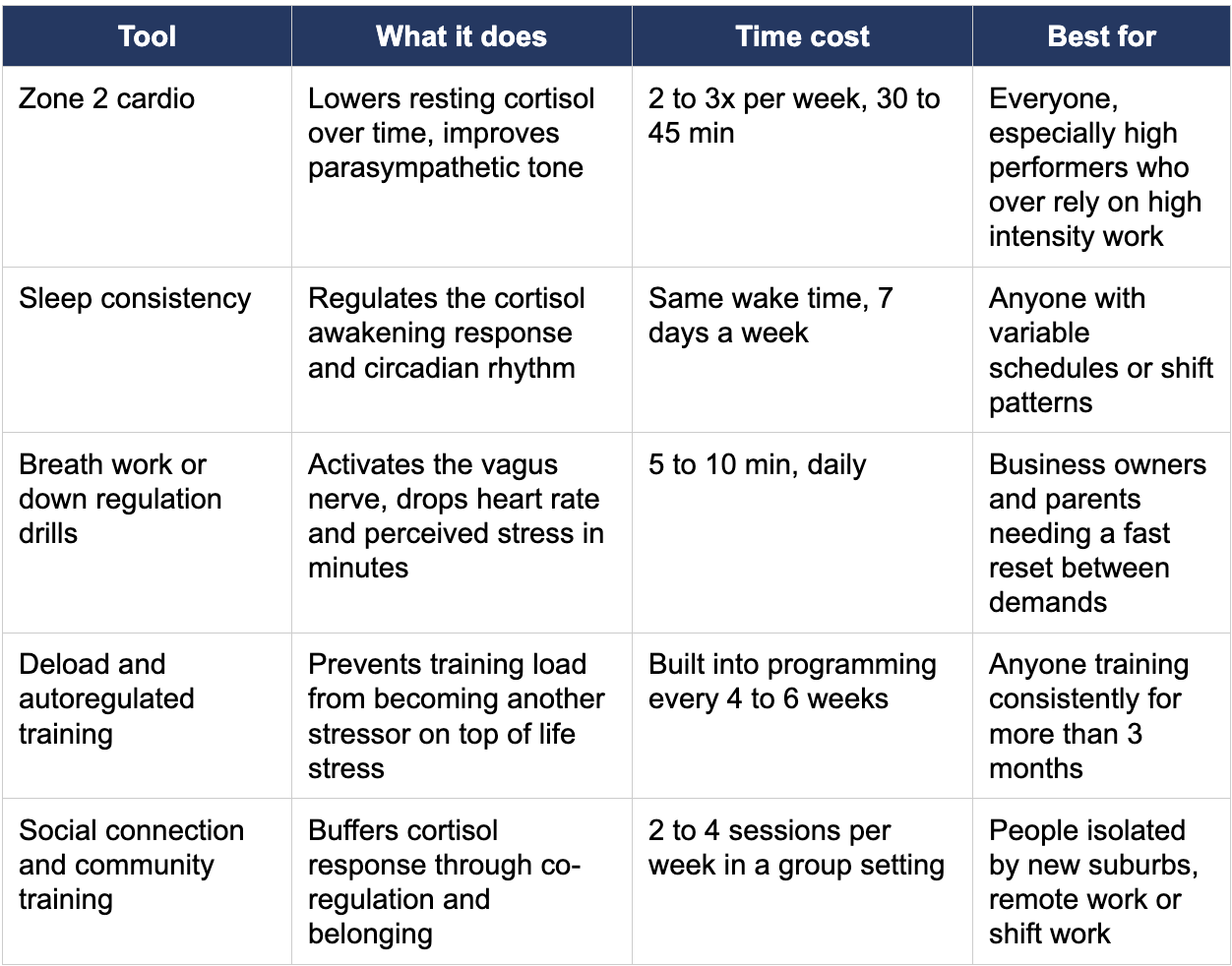
None of these tools require an overhaul of your life. Most of them can be layered into a week that already includes training, in ten minutes here and there, and the combined effect on cortisol regulation is meaningfully larger than any single one used in isolation.
Each row in that table is backed by a specific evidence base. Sustained Zone 2 training has been shown to increase heart rate variability over time by shifting the balance of the autonomic nervous system toward parasympathetic dominance (Zone 2 training and autonomic nervous system research). Slow, paced breathing at around five to seven breaths per minute has been shown in controlled studies to significantly increase cardiac vagal activity compared with normal spontaneous breathing, with measurable reductions in reported stress (slow paced breathing and vagal tone studies). On the social side, a controlled study using the Trier Social Stress Test found that participants who received support from a friend, particularly combined with oxytocin, showed the lowest cortisol response and the greatest calm under pressure (Heinrichs et al., 2003, Biological Psychiatry). And on training structure, current periodization research puts typical deload timing at every four to eight weeks of progressive loading, specifically to manage fatigue before it compounds into the kind of overreaching discussed in Chapter Five (deload periodization research, strength and physique sports).
Chapter 9: Building Stress Awareness into Your Byford Training Plan
For many of our Byford members, the biggest stress load is not dramatic, it is cumulative. A long commute up the highway into Perth or Armadale, a full day of work, school pickups, and then trying to find the energy to train in the evening. Business owners in the area carry an additional layer, the mental load of running a team and managing cash flow that does not switch off when the workday ends.
Building stress awareness into a training plan means being honest about which weeks are genuinely low stress and which are running hot, and adjusting intensity accordingly rather than forcing the same output regardless of context. A demanding week at work is not a reason to skip training altogether, movement itself helps regulate cortisol, but it may be a reason to shift that week toward Zone 2 cardio and mobility work rather than a maximal strength session that adds another significant stressor on top of an already taxed system.
Commuting research gives this local context real weight. Studies of car commuters have found commute duration predicts perceived stress and physiological markers including blood pressure, heart rate and cortisol, and that journeys over roughly 60 minutes are associated with meaningfully worse outcomes across sleep quality, vitality and self-reported health (commuting and health outcomes research, Sweden and UK based studies). With the Byford train line into Perth only recently opening as part of the broader Metronet works, a large share of our members were, until recently, absorbing exactly this kind of commute related load every working day.
Chapter 10: The Coach's Role, Programming Around Life, Not Just Around Reps
This is the core of how we coach at LPFIT. A program written in isolation from a member's actual life is a program that will eventually fail, not because the exercise selection was wrong, but because it ignored the recovery capacity available to absorb it. Autoregulation, adjusting load and intensity session to session based on how a member is actually presenting, is not a compromise on results, it is what makes long term results possible.
Practically, this means our coaches ask about sleep, work load and general life stress as a normal part of checking in, the same way they check in on a niggling shoulder. It means a heavy week at work might mean scaling back load by ten to fifteen percent rather than pushing through. It means celebrating consistency over any single session's intensity. Training is one of the few tools available that can both reflect life stress and help regulate it, and coaching well means using it as the second, not accidentally adding to the first.
Autoregulation itself has a growing evidence base. A 2025 systematic review and network meta-analysis found that autoregulated approaches, including RPE based training, outperformed fixed percentage based prescriptions for building maximal strength, in part because autoregulated groups naturally trained at higher effective intensities on their good days and pulled back appropriately on harder ones (autoregulated resistance training network meta-analysis, 2025). This is the mechanism, not just the philosophy, behind why programming around a member's actual readiness produces better long run outcomes than a spreadsheet that assumes every week is identical.
Summary
Cortisol is not the enemy, chronic, unmanaged stress is. It works against body composition goals through concrete mechanisms, raised blood sugar, increased cravings and muscle protein breakdown, and it undoes training progress by removing the recovery phase that adaptation depends on. The fix is not to train less or to add vague relaxation advice, it is to build specific, low time cost stress management tools into your week and to train in a way that accounts for the life you are actually living, not the life a generic program assumes you have. Do that consistently, and the results that have been stubbornly out of reach usually start to move.
Want a Program That Actually Works?
At Life's Peachy FIT Byford, every member trains with structure, progression, and a community that holds them accountable. No more guessing. No more spinning your wheels.
Come in for a free trial. Meet our coaches. See what happens when your training, your sleep, & your nutrition all point in the same direction.
Life's Peachy FIT Byford
www.lifespeachyfit.com | Byford@lifespeachyfit.com
Sources
Bouchard C, et al. Familial aggregation of VO2max response to exercise training: results from the HERITAGE Family Study. Journal of Applied Physiology, 1999. See also systematic review on trainability classification, Frontiers in Physiology, 2021.
Reviews of hypothalamic pituitary adrenal axis physiology and acute stress response, stress neuroscience literature.
Research on cortisol receptor density in visceral adipose tissue. Epel ES, et al. Stress and body shape: stress-induced cortisol secretion is consistently greater among women with central fat. Psychosomatic Medicine. Tomiyama AJ, Dallman MF, Epel ES. Comfort food is comforting to those most stressed: evidence of the chronic stress response network in high stress women. Psychoneuroendocrinology, 2011.
McEwen BS, Stellar E. Stress and the individual: mechanisms leading to disease. Archives of Internal Medicine, 1993. McEwen BS. Stress, Adaptation, and Disease: Allostasis and Allostatic Load. Annals of the New York Academy of Sciences, 1998.
Cadegiani FA, Kater CE. Hormonal aspects of overtraining syndrome: a systematic review. BMC Sports Science, Medicine and Rehabilitation, 2017. Williams JM, Andersen MB. Psychosocial antecedents of sport injury and interventions for risk reduction, applied in athlete cohort studies.
Takahashi Y, Kipnis DM, Daughaday WH. Growth hormone secretion during sleep. Journal of Clinical Investigation, 1968, and related slow wave sleep deprivation studies. Systematic review and meta-analysis on acute sleep deprivation and cortisol, 2024.
Heart rate variability monitoring studies in adolescent swimmers and judo athletes, sport science and conditioning literature.
Zone 2 training and autonomic nervous system adaptation research. Slow paced breathing and vagally mediated heart rate variability studies. Heinrichs M, Baumgartner T, Kirschbaum C, Ehlert U. Social support and oxytocin interact to suppress cortisol and subjective responses to psychosocial stress. Biological Psychiatry, 2003. Deload and periodization research in strength and physique sports, Frontiers in Sports and Active Living, 2022.
Commuting time, perceived stress and physiological health outcomes research, Sweden and UK based commuter studies.
Autoregulated resistance training for maximal strength enhancement: a systematic review and network meta-analysis, 2025.