
Why Group Training is the Most Lucrative Business Model in Fitness
There's a version of the fitness career that nobody warns you about.
Lisa worked in your typical 9-5 admin role since leaving school. She loves the fitness industry, is training in the gym 5-6 days per week & has a passion for educating people to improve their life with fitness. She wanted a change & started looking for jobs. A personal trainer role was advertised at a big box gym, offering $100-$120 per hour, seems like a no brainer compared to her measly $31 per hour in admin. Intrigued with the role, Lisa signed up to study the certificate 3&4 in fitness & personal training.
4 months later & her certification in hand, Lisa applied for a role at a big box gym. 2 weeks later she had her first day as a personal trainer.
Over the next few months, Lisa started to build her client base. She worked hard, early mornings, late nights, phone calls to the database & high energy whilst she was client facing. 6 months later, Lisa’s calendar is almost full. But she’s completely exhausted. She wasn’t aware of all the tasks needed to keep her business running on top of servicing her clients. She was essentially running a business, not to mention, whilst being in competition with about 13 other personal trainers in the same gym & fighting over the same clients. Her $100-$120 per hour is more like $20-$25 per hour with business admin tasks. Lisa thinks to herself, I can't even take sick days without losing part of my income. She then realises she built a job, not a business.
For many years, this was the reality of personal training - exchanging your time for their investment. The ceiling was fixed by the number of hours in a day & how many PT sessions you could squeeze in. Personal trainers had the same problem, more clients = more hours, but not more freedom.
Then, Lisa discovered: The ‘group training model’.
The group training model rewrote the economics for fitness professionals. Suddenly, 1 qualified fitness professional could now help 10+ clients achieve real results in the same hour they used to spend with one. In addition, the accountability from fellow participants resulted in higher adherence to their fitness program, forming a new retention strategy: the ‘community’, and these sessions are now an ‘experience’. These businesses are now able to scale.
In Australia, the evidence is hard to ignore. The fitness industry made a staggering $2.9 billion in revenue in 2024, and boutique group studios are leading the charge, with many big-box gyms consolidating. Group fitness members are 56% less likely to cancel than solo gym goers. The model isn't a trend. It's the direction the whole industry is moving.
This article is for fitness professionals still trading hours, like Lisa. The one who knows their model isn't sustainable but hasn't yet found a clear path to something better. What follows is why group training is a lucrative business model, and what it could mean for yours.
Chapter 1: The Broken One-on-One Model
Lisa's first 6 months as a personal trainer felt like a success story.
Full calendar. Happy clients. A reputation building inside the gym. From the outside, she was doing everything right. But the numbers told a different story.
She was working 50+ hours per week. Early morning sessions started at 5am. Late evening sessions finished at 7:30pm. In between, she was writing programs, responding to client messages, chasing unpaid invoices, marketing her services & trying to find new clients to replace the ones who'd dropped off. The $100–$120 per hour rate she was sold on had quietly become $20–$25 per hour when you factored in all the hours the gym wasn't paying her for.
And she wasn't alone.
This is the reality for the majority of personal trainers in Australia. The average PT earns between $50,000–$90,000 per year, not bad on the surface, but the hours required to hit that number are unsustainable for most people long term. The fitness industry has a well-documented burnout problem, with personal trainer turnover estimated between 50–80% within the first two years. These aren't lazy people. They're hardworking professionals trapped inside a model that was never designed to scale. They were ‘sold’ the Personal Training ‘dream’.
The one-on-one personal training model is built on a simple but flawed exchange: your time for their money. You sell an hour. You deliver an hour. You get paid for that hour. The moment you stop, the income stops. There's no leverage.
The trainers who do make serious money in the 1-on-1 model typically fall into one of 2 categories: they charge premium rates ($150–$300+ per session) to a very specific high-income avatar, or they work themselves into the ground trying to compensate with volume. Neither is a sustainable business model for the average fitness professional.
What made it worse was the environment Lisa was working in. 13 personal trainers. One gym floor. The same pool of members walking through the same doors every day. It wasn't just a hard business model, it was a competitive one. PTs weren't just trying to build a business. They were trying to survive inside a bigger one.
The one-on-one model had both a ceiling…. And a trap door!
Chapter 2: The Turning Point - What is Group Training?
Lisa didn't stumble across group training. It found her.
A friend invited her to a local boutique studio. A small space, 10 people, one coach running a structured 45-minute session. No machines. No mirrors lined with strangers doing their own thing. Just a group of people working through the same program together, coached by the same person, at the same time. Lisa had a great understanding of exercise selection & how to program for general health & fitness, and she noted the exercises she’d completed in the class, were exercises she would have programmed for herself & clients as a PT. Lisa finished the session dripping in sweat, laughing with people she'd never met & already thinking about when she'd come back.
On the drive home, she had one thought: why isn't this what I'm doing?
Before we go further, let's clear something up. When most people hear "group training," they picture a boot camp in a park. 20 people doing burpees in the rain. A trainer with a megaphone. That's not what we're talking about.
The group training model that changed the fitness industry is something different. It's structured, intentional & built around a repeatable system. It typically looks like this: a small to medium sized group (anywhere from 6 to 24+ people), a qualified coach (or two) delivering a pre-programmed session, a consistent timetable that members book into, and a community that forms around the shared experience of showing up together. It's semi-personalised, not one-on-one, but far from anonymous.
The key word here is system. The best group training businesses aren't just running classes. They're running programs. There's a logical progression from week to week. There are accountability check-ins, benchmarks for members to hit & measurable outcomes. Members aren't just turning up, they're working towards something. That's what separates a group training business from a fitness class, and it's what drives the retention numbers we'll get into later.
The model also evolved to fit different markets. You've got large format group training like F45 & CrossFit, global franchises with hundreds of locations built entirely on this concept. You've got boutique studios running specialised programs for specific populations: women, athletes, over-50s, post-rehab clients. And you've got independent coaches, like Lisa would eventually become, running their own small-group programs out of a rented space, or a private facility.
What they all have in common is the core shift: one coach, multiple clients, one hour.
In Australia alone, this model helped grow the fitness industry to $2.9 billion in revenue in 2024. Boutique group studios are expanding while big-box gyms consolidate. The number of gym & fitness centres in the country sits at approximately 6,583, and the ones driving growth aren't the ones with the most treadmills.
Lisa's realisation on that drive home wasn't just about finding a better workout. She was looking at a better business model. She just didn't know it yet.
Chapter 3: The Economics That Changed Everything
Lisa was a good personal trainer. That was never the problem.
The problem was the model she was working inside. And the moment she sat down and actually ran the numbers, everything became clear.
Let's do the same thing now.
As a personal trainer, Lisa was charging $100 per session. On a good week, she'd deliver 25 sessions. That's $2,500 in revenue, before tax, before the gym's commission cut or rent, before the hours she wasn't being paid for. The ceiling on that number wasn't her ability. It was hours in the day. There are only so many hours in a day, and only so many days before you burn out.
Now look at what the group training model does to that same hour:
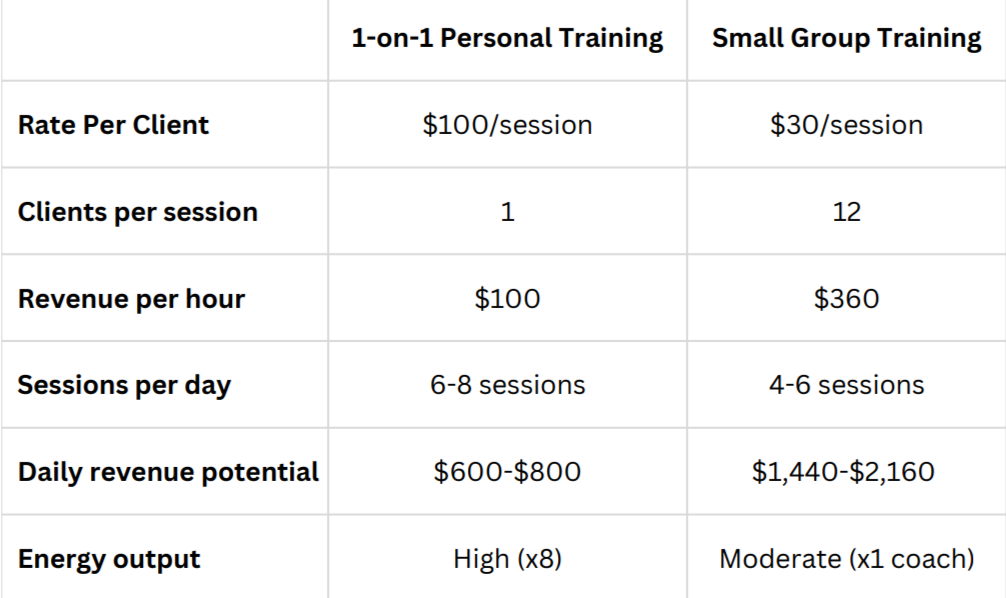
Same hour. Same qualified professional. More than 3× the revenue, with less individual energy output per client.
This isn't theory, it’s fact.
The group model doesn't just improve your income, it restructures the entire relationship between your time & your earning potential. One session with 12 people at $30 each generates $360. Lisa used to need over 3 PT sessions to match that number. Now she needs one hour & a full room.
The Break-Even Reality
One of the most common reasons fitness professionals don't make the move to group training is the perceived risk of setting up their own space. But the numbers don't support that fear.
A PT rental agreement at a commercial gym typically costs between $200–$400 per week, depending on location. A small group training room, a rented space of 80–120 square metres in a shared facility or light industrial unit, runs anywhere from $400–$800 per week in most Australian cities.
Here's what break-even looks like in a simple small group model:
Weekly rent: $600
6 sessions per week × 10 clients per session × $35 = $2,100/week in revenue
Break-even is hit after just 2 sessions
The remaining 4 sessions are profit
Lisa wasn't just looking at a better income. She was looking at a business that covered its costs before lunchtime on Tuesday.
Compare that to the PT rent model, where every dollar of rent comes directly out of session revenue earned one client at a time, and you start to understand why so many experienced trainers eventually make the shift.
What the Industry Numbers Confirm
The macro data backs up what the micro maths already shows. Australia's fitness industry reached $2.9 billion in revenue in 2024, recovering strongly from the pandemic years. Boutique group studios are driving the majority of that growth while large format gyms consolidate & downsize. F45, one of Australia's most successful group training exports, (fun fact: we were once an F45 Franchisee) reported average gross revenue of $354,000–$633,000 per location per year, with profit margins above 30% & average full payback on investment in under 9 months. For context, we opened F45 Training Byford in March 2017, and by January 2018, we had a monthly revenue of $700,000+.
These aren't outliers. They're evidence of a model that works at scale, in multiple markets, across different demographics.
The economics of personal training were never broken because trainers weren't good enough. They were broken because the model was built on the wrong unit of measurement. Trading hours for dollars is a ceiling. Delivering value to a group is a lever.
Lisa finally had a lever.
Chapter 4: Community Became the Product
Lisa noticed something strange in her first month at the boutique studio.
People were arriving early.
Not because they had to. Not because the coach was chasing them. They were arriving early to talk to each other. To catch up on the week. To ask about each other's kids, their footy games, their work stress. The relationship troubles they’ve been having. The session hadn't even started & the room was more vibrant then a big box gym with 10% of the people in it. She'd never seen that in a big box gym.
This is what the group training model quietly figured out before most of the fitness industry caught up: people don't stay because of results. They stay because of belonging. They feel a part of something bigger then themselves.
Results get them in the door. Community keeps them coming back.
The research backs this up. Group fitness members are 56% less likely to cancel their membership than solo gym members. They stay an average of 22% longer. Members who attend group classes are 26% more likely to still be a member 12 months later. Boutique studios run average retention rates of 70–80%, compared to 60% for traditional gyms. Shameless plug: 97% retention for us at Life’s Peachy FIT ;-).
That gap isn't about programming. It's about identity.
When someone becomes a regular at a group training facility, they don't just become a client, they become a member of something. Their training buddies know their name. The coach knows their goals. Missing a session means letting people down, not just skipping a workout. That psychological shift is worth more to a business than any referral campaign or promotional offer. At our facility in Byford, we gave a nickname to one of our 60+ members who’s been with us for 9 years. He’s at every 5am class Monday-Saturday without fail (unless a work trip got in the way), and he’s the kind of member that EVERY gym wants (and needs). His nickname is: ‘The GymFather’.
Researchers call this social identity theory. When people form a strong group identity around a shared activity, especially a physically & emotionally demanding one, their adherence to that activity increases significantly. Studies on group cohesion & exercise (Beauchamp et al.) consistently show that people who feel a strong sense of belonging to a fitness group exercise more frequently, work harder during sessions & maintain their habits over longer periods than those training alone.
This isn't exclusive to the fitness industry. The military has studied group cohesion for decades and the research consistently shows that soldiers with strong unit bonds perform better, stay longer & handle adversity more effectively than those without it. Alcoholics Anonymous documented the same effect in recovery: people who genuinely felt they belonged to the group had an 82% retention rate over 10 years. Not because of the program. Because of the identity. The group training model works for the same reason. When someone becomes part of something, they don't want to leave it.
The group training model didn't just change the business model. It changed the psychology of the client's relationship with fitness.
Lisa had been trying to be her clients' motivation for years. Now she understood, the group does that job for you. The coach just has to create the environment.
When you stop selling sessions & start selling a sense of belonging, you don't just improve retention. You build something that people genuinely don't want to leave.
Chapter 5: What It Did for the Professional, Not Just the Business
Most conversations about group training focus on the client experience or the revenue numbers. Not enough people talk about what it does to the professional delivering it.
Because the fitness industry has a problem it doesn't like admitting.
Most personal trainers don't last. Industry turnover is estimated between 50–80% within the first two years. Not because people aren't passionate about fitness. But because the 1-on-1 model is physically & emotionally exhausting, financially unpredictable & professionally isolating. You pour everything into your clients, one at a time, five or six times a day & then you go home, write programs alone & wonder if it's all worth it.
The group training model changed that equation for a lot of coaches. Not just financially, but professionally.
When you're coaching a group, your energy has leverage. You're not depleting yourself client by client, you're amplifying your impact across a room of people who feed off each other's energy & yours. Coaches who make the shift consistently report that coaching 10 people in a group session is less draining than coaching 6 individual PT sessions in a day. You finish the session energised, not empty.
There's also the craft of it. Group training demands a higher level of coaching skill, the ability to read a room, cue movements across different bodies simultaneously, manage energy, control the room with your voice, build culture & deliver a session that feels personal even in a group setting. You also need to be an excellent DJ ;).
That challenge keeps coaches growing. It keeps the work interesting. It gives you something to get better at.
The financial picture shifts too. F45 franchise owners report average gross revenue of $354,000–$633,000 per location per year, with profit margins above 30%. Independent boutique studio owners running small group models in Australia regularly report incomes of $120,000–$200,000+ once their timetable is full, with more control over their hours than any regular PT contract.
But the most underrated thing the group model gives fitness professionals isn't the money. It's a reason to stay.
Lisa had been close to quitting twice in her first two years as a PT. Not because she didn't love fitness. Because the model she was working inside was chipping away at her will to keep going. The group training model gave her a business she could build, a community she was proud of & a career with an actual future in it.
The industry loses too many good coaches to burnout & bad economics. The group model is one of the clearest paths to keeping them.
Chapter 6: The Hybrid Advantage - Group Training Meets Allied Health
Here's a question most fitness professionals haven't asked themselves.
What happens when you take the group training model - the community, the retention, the scalability & add clinical credibility to it?
This is the frontier. And in Australia, it's still largely wide open.
The allied health & fitness hybrid model brings together two things that have historically operated in separate lanes. On one side, you have physiotherapists, exercise physiologists & other allied health professionals - highly credentialled, Medicare-recognised, trusted by the medical community, but typically capped by an appointment-based model that maxes out at 8–10 clients per day. On the other side, you have the group training model: scalable, community-driven & financially leveraged, but sometimes lacking the clinical depth to serve complex or injured populations. Both with the goal of improving their clients’ Health & Wellbeing.
When you combine them, the result is something neither can achieve alone.
Think about what that looks like in practice. A physiotherapist running a private practice sees 8 clients a day at $150 per session - $1,200 in daily revenue with a full calendar. The same clinician adds a group exercise program to their offering: 3 group sessions per day, 10 participants per session at $30 each - an additional $900 in daily revenue, running simultaneously with their clinical work if they have a support coach on the floor.
That's not a marginal improvement. That's a structural shift in what the business can earn.
The dual income stream goes further. Allied health professionals in Australia can bill Medicare & private health funds for eligible group services - chronic disease management programs, exercise physiology group sessions & supervised rehabilitation classes can all attract rebates. When you stack Medicare-eligible clinical billing with a premium group training model, you're operating a business with multiple revenue channels feeding the same facility.
The clinical populations are where the real opportunity lives. Physio-led group exercise programs are already proving their value across cancer rehabilitation, cardiac recovery, aged care, injury prevention & chronic pain management. These aren't boot camp clients - they're people with specific needs, high trust in their clinician & a genuine medical reason to show up consistently. Retention in clinical group programs is exceptionally high because attendance isn't just a lifestyle choice. It's part of their recovery.
This is the model Life's Peachy Fit was built on. Not choosing between clinical credibility & scalable fitness - combining them into something the market hasn't fully seen yet.
The allied health professional who only runs appointments is leaving money on the floor. The group fitness coach who lacks clinical depth is leaving a client demographic untouched. The hybrid model closes both gaps at once.
Chapter 7: The Model Isn't Perfect - Here's What to Get Right
It would be easy to read everything above & think the group training model is a guaranteed win. Build the timetable, fill the room, print the money.
It's not that simple. And the professionals who treat it like it is don't last.
The group training model has ways it can fail. Understanding them isn't a reason to avoid the model - it's the reason the coaches who run it well have a significant competitive advantage over the ones who wing it.
Programming quality is non-negotiable. The worst version of group training is a coach showing up with a whiteboard full of exercises & no logical progression from week to week. Clients tolerate this for a few months - then they plateau, lose interest & leave (one of the many reasons we decided to cancel our franchise agreement with F45 & rebrand to Life’s Peachy FIT). The best group training programs are periodised, benchmarked & progressive. Members can see themselves improving. That's what drives long-term retention. A class is forgettable. A program creates loyal clients.
Supervision ratios matter more than most operators admit. Exercise & Sports Science Australia (ESSA) - the peak body governing degree-qualified fitness professionals in this country — sets professional standards for group exercise delivery. There's no single published ratio that fits every context, but the principle is clear: the coach-to-client ratio should reflect the complexity of the movement, the vulnerability of the population & the space available. Running 25 people with one coach through technically demanding compound lifts isn't group training. It's a liability.
Insurance & scope of practice are serious. This is especially true for the hybrid allied health model. Knowing exactly what you're covered for, what your qualifications permit & where your scope ends isn't paperwork - it's the difference between a sustainable business & a career-ending incident.
Don't race to the bottom on price. This one kills more group training businesses than any other mistake. A coach who underprices their sessions to fill the room faster signals low value, not accessibility. Pricing psychology research consistently shows that clients who pay more for a service perceive it as more valuable, invest more effort in it & stay longer. If your sessions are worth $35–$45, charge $35–$45. The clients you attract at that price are the ones who will stay, refer others & build your community.
Lisa learned most of these lessons the hard way in her first year running her own program. The ones she got right from the start gave her a foundation. The ones she got wrong cost her clients she didn't need to lose.
The model works. But it rewards the professionals who take it seriously.
Chapter 8: Where the Model Goes Next
The group training model isn't finished evolving. In fact, the next version of it is already being built.
The online fitness space - which exploded during COVID & never fully contracted — is now a permanent feature of how people train. The global virtual fitness market was valued at $26.88 billion in 2024 & is projected to hit $295 billion by 2033. Online group training specifically is forecast to grow from $28.89 billion in 2025 to $98.73 billion by 2030. These aren't niche numbers. This is a structural shift in how fitness is delivered & consumed.
For the group training coach, this isn't a threat - it's an expansion of the model. The same community dynamics that make in-person group training sticky translate online. A coach running a hybrid model - in-person sessions 3 days a week, supplemented by online group programming, check-ins & community - isn't just serving more clients. They're building a business that isn't limited by geography or facility size.
The second shift is the move toward niche micro-communities. The era of the general fitness class is giving way to highly specific cohorts. Programs built exclusively for mothers returning to training post-partum. Senior athletes. Corporate professionals. Clinical populations. Teenagers in structured athletic development programs.
The more specific the community, the stronger the identity & the higher the retention.
This is exactly where the Life's Peachy Sports Performance Academy sits. Not a general fitness program. A purpose-built development environment for junior athletes aged 13–18, structured around athletic performance, injury prevention, mindset & the kind of elite standards that most programs for this age group don't demand. It's a micro-community with a clear identity, a specific avatar & a coaching philosophy that filters the right athletes in & the wrong ones out.
Technology is accelerating all of this. App-based training platforms, AI-assisted program design, wearable performance tracking & automated check-in systems are reducing the administrative load on coaches & improving the data available to drive client results. The coaches who adopt these tools intelligently won't just work smarter, they'll be able to serve more people at a higher standard without burning out.
The group training model changed the game for fitness professionals a decade ago. The next decade will belong to the coaches who build niche communities, leverage technology & deliver clinical-quality outcomes at group-training scale.
The question isn't whether the model works. The question is whether you're ready to build one.
In Summary,
We started this article with Lisa.
Qualified, passionate, hardworking & completely trapped inside a model that was never going to give her what she came into this industry for.
She's not a cautionary tale. She's the majority. Right now, there are thousands of fitness professionals across Australia sitting in the same position she was. Full calendar, empty tank, doing the numbers on a career that doesn't add up.
The group training model isn't a magic solution. It takes work to build, discipline to run, genuine coaching skill to deliver well & just being a decent human being. But the fundamentals are undeniable. One qualified professional. Multiple clients. The same hour. A community that creates its own retention. A business that scales.
You can keep trading hours. There's nothing wrong with that choice if it's working for you.
But if it's not, if you're booked out & still not where you want to be, if you're exhausted by a model that caps your income by capping your time, if you know deep down that what you're building is a job & not a business - then you already know what the next step looks like.
The question is whether you're ready to take it.
If you're a personal trainer, physiotherapist or fitness professional looking to build a group training model that actually works, Life’s Peachy FIT is now offering franchise opportunities. We have systemised our business model & would love to partner with you. For a free discovery call, book here: https://api.leadconnectorhq.com/widget/bookings/lpf-franchise-discovery-call